
Chưa phân loại
Valentino Signature Handbags Pyramid Stud Icon
The Rockstud Bag: How It Began, What You Pay
No detail this house makes is more recognisable than flat pyramid studs, set in rows along an edge or scattered across a flap. It is equally the broadest and cheapest section of the leather goods collection: roughly fifty-two pieces were live on the brand’s own US site in September 2026. Prices observed run $1,250 to $2,100 — below the evening bags and under most of the shoulder lines. Put those together and you have the reason it is usually the first Valentino bag anyone buys. Below: the origin of the motif, the shapes on sale now, the observed price for each, how Rockstud Spike differs, and how the line behaves on resale. The figures are market prices seen on the brand’s own webstore — not an official price list.
The origin of the studs
The Rockstud motif was introduced in the Fall 2010 collection by Maria Grazia Chiuri and Pierpaolo Piccioli, then co-creative directors, and it appeared first on footwear. The source cited for it is Roman bugnato rustication, the faceted projecting stonework seen on Renaissance palazzo facades in the city where the house was founded in 1960. That explains the stud: a shallow four-sided pyramid with a flat top, far closer valintinobags.com/shoulder-bags to masonry than to punk hardware. Valentino Garavani, the founder, sold the company in 1998, retired from design in 2007 and died on 19 January 2026. The motif is therefore entirely the work of the designers who followed him. The widely repeated claim that the Rockstud bag launched in 2016 rests on a single source alone and should not be treated as established.
Which shapes you will actually find
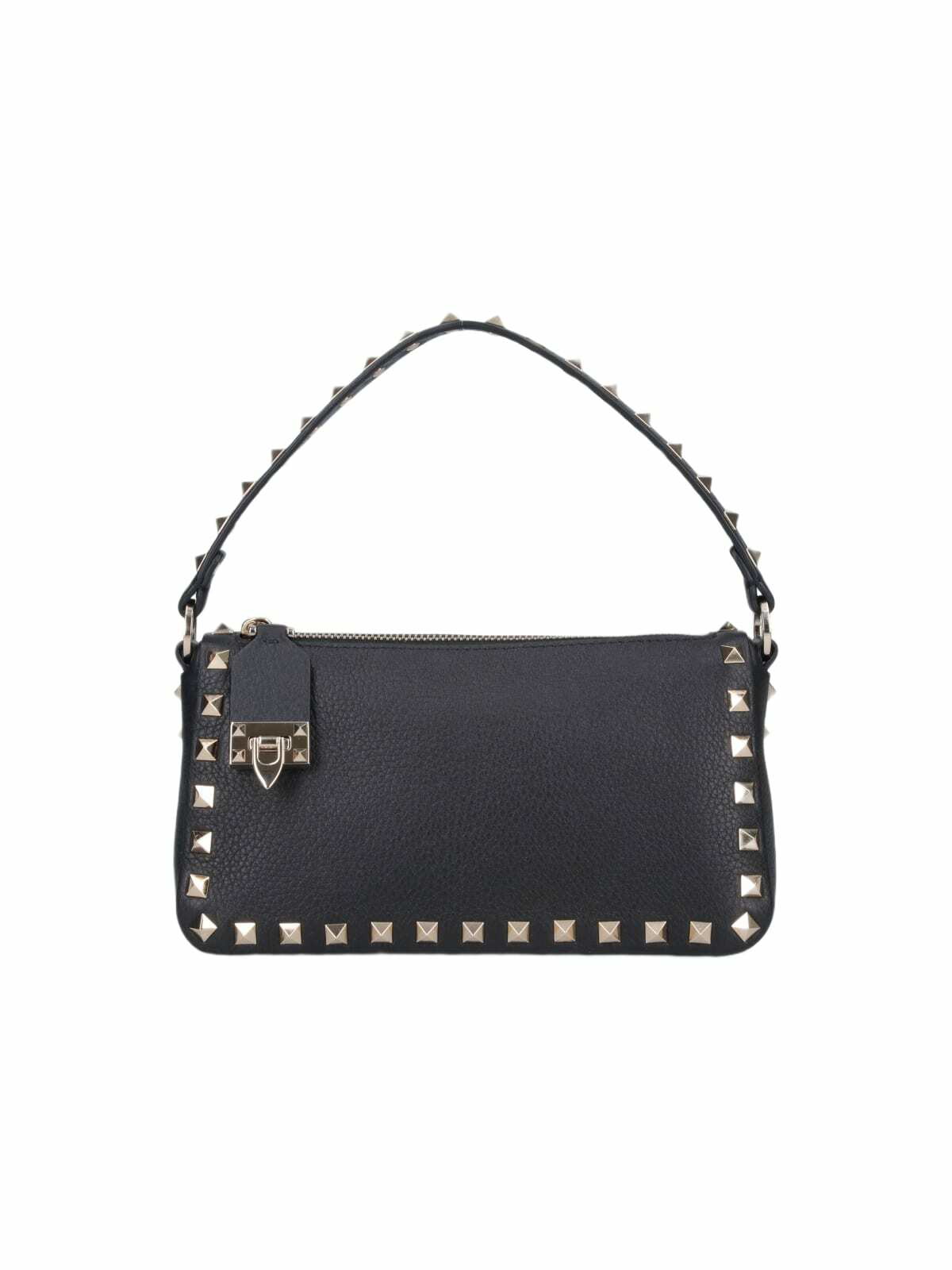
Rockstud is a motif applied across a family of shapes, not a single bag. On the product pages, naming is by size and function instead of by model number. The family clusters around four things: a mini shopping tote, a small crossbody, a small shoulder bag, plus wallets and small leather goods. Sizes are quoted as small and mini throughout, so the line stays compact even where the word shopping appears. Most of the gap between two otherwise identical bags is a matter of material and hardware finish. Made in Italy throughout, per the brand’s own product pages confirm.
The mini shopping tote
The cheapest genuine entry — and the most practical Valentino tote bag at this price. It was seen at $1,390 in grainy calfskin or suede, at $1,490 in raffia, at $1,750 in laminated calfskin and at $1,850 in pony-effect calfskin. Finish, not construction, drives the spread, so paying more buys a surface rather than extra capability. Take grainy calfskin as the durable default, raffia as seasonal and more delicate, and the laminated and pony-effect finishes as the ones that scuff. It is a mini, so it carries a phone, a small wallet and keys rather than a working day’s contents. If a full-size shopper is the requirement, VLogo Signature shopping bags, observed between $2,650 and $3,750, are the place to look.
The crossbody, the shoulder bag and the chain wallet
The small crossbody does the heavy lifting, recorded at $1,650 to $1,950 in grainy calfskin and $1,790 in laminated calfskin. At $1,250, a laminated calfskin wallet doubles as a chain wallet — the cheapest way into the motif in a wearable format. Heading the standard range is the small shoulder bag at $1,950 in suede and $2,100 in grainy calfskin. There is one quirk to be aware of: the brand’s own US site does not maintain a crossbody category page at all. Its bag navigation runs through shoulder bags, totes, top handle bags, clutches, wallets and small leather goods, so a Valentino crossbody bag has to be found under shoulder bags there, even though major retailers keep dedicated crossbody pages. Most of these styles ship with a removable, adjustable strap and work either way.
Rockstud Spike, the quilted sibling
Rockstud Spike is not a variant but a separate line, and it costs considerably more. Prices observed run $2,400 for a crossbody clutch up to $3,700 for a medium embroidered nappa piece. The differences are quilting and a chain — and studs set into the quilted surface rather than ranged along an edge. Material drives price here too: small suede at $2,550, small nappa at $2,800, medium kidskin at $2,950, medium suede between $2,750 and $3,200, and medium nappa at $3,500. This is an evening bag, which the standard Rockstud is not, and it sits closer to the Locò and VSling families. If the studs are wanted with a chain strap and a softer body, this is the line.
Prices as observed in 2026
Everything quoted above is pulled together into the table below. They were seen on the brand’s own US webstore in September 2026 and amount to a market snapshot rather than an official price list. Two things are worth noticing. The first is that standard Rockstud holds a narrow band, $1,250 to $2,100, never reaching the house’s top tier, where embroidery, crystals and exotic skins push bags past $7,000. Second: Rockstud Spike picks up roughly where standard Rockstud leaves off, so there is very little overlap. Official seasonal sales are run on the house’s own site, and as of September 2026 the US sale page states that the Spring/Summer 2026 sale has ended — a Valentino bag sale is a periodic event, and not a permanent condition.
| Bag | Material used | 2026 market price observed |
|---|---|---|
| Rockstud chain wallet | Laminated calfskin | $1,250 |
| Rockstud mini shopping | Grainy calfskin or suede | Observed at $1,390 |
| Rockstud mini shopping | Raffia | Observed at $1,490 |
| Rockstud small crossbody | Grainy calfskin | From $1,650 to $1,950 |
| Rockstud mini shopping | Pony-effect calfskin | $1,850 |
| Rockstud small shoulder | Grainy calfskin | $2,100 |
| Rockstud Spike medium | Embroidered nappa | $3,700 |
What it is made of, and how to keep it
Across the family, nappa, grainy calfskin, laminated grainy calfskin, suede, kidskin and pony-effect calfskin are the leathers observed, with raffia appearing on seasonal pieces. Hardware finishes seen on current stock include antique brass, light gold and a platinum-toned metallic. On a genuine piece the studs are uniform pyramids, evenly spaced and firmly seated; the logos are engraved rather than printed; the zip pulls are squared with deep engraving. The interior tag reads VALENTINO and GARAVANI in capitals with MADE IN ITALY, sewn down on all four sides, the surname being an obligation of a 1979 coexistence agreement with the unrelated Naples company Mario Valentino. Most bags have a serial number on a tag inside an interior pocket, but not all do and older pieces may carry none, so its absence proves nothing, and no date-code system exists to decode. Day-to-day care follows general luxury-leather practice rather than official instruction from the house.
- Grainy calfskin and nappa — dry cloth, nappa cream, blotting for stains, air drying away from heat.
- Suede and kidskin: dry brushing, a protector spray, and no water or oils.
- Laminated and pony-effect finishes: the coating fails first, so avoid abrasion.
- Storage — dust bag, tissue stuffing, cool and dry, out of sunlight.
How well the line holds value
Of the whole collection, Rockstud is what resale data rewards — but the numbers describe market behaviour, not an investment case. Rebag’s figures put average retention for Valentino handbags at around 41 per cent, measured in 2023, and several Rockstud shapes sit above that. House-wide, the pattern is consistent, with immediately legible motifs holding value and plain bags failing to. One single-source data point has a medium Rockstud Spike trading around $1,700 against roughly $2,900 new, close to sixty per cent. The pre-owned inventory at one aggregator spans $54 to $6,300, averaging near $817. Fashionphile, The RealReal, Rebag, Vestiaire Collective and 1stDibs all carry it, so checking the tracked retention figures below takes no time at all.
- Rockstud drawstring bucket, 56 per cent of original price.
- Rockstud flip lock flap: 56 per cent.
- Rockstud pouch crossbody, 50 per cent of original price.
- Valentino handbags overall in 2023, 41 per cent.
Is it worth it for you?
The argument for the Rockstud is practical rather than prestige-driven, and it stands on three points. It is the cheapest route into the house’s leather goods in a real bag shape, it is the most recognisable thing the brand makes, and it resells above the house average. Against that, the studs date a bag to a specific design era, the mini sizes are genuinely small, and the delicate finishes ask for care. For a single bag in daily use, the sensible choice is the small crossbody or the small shoulder bag in grainy calfskin. For evenings, Rockstud Spike works better, at roughly a thousand dollars more. Buy from the house’s own boutiques and webstore or from named authorised retailers such as Neiman Marcus, Saks Fifth Avenue, Nordstrom or Mytheresa, and check the interior tag first.